GuidesAI and agents
AI agents: connecting them to real data
What an agent really is
A language model on its own writes text. An agent is a model that has been given three things:
- A modelIt writes text.
- +
- ToolsRead a database, query an API, write to a system.
- +
- ContextUp-to-date business data, fetched when it answers.
- +
- A bounded missionWhat it does, what it does not, when it stops.
- =
- An agentA colleague who does part of the work.
And around it, guardrails
- A checkerAn agent reviews, then a human.
- Rules in the codeNot in a prompt.
- A capped budgetA runaway loop stops itself.
- Tests on real casesReplayed after every change.
Without tools and data, you have a writer. With them, you have a colleague who does part of the work.
Start from the data, not the model
The quality of an agent is decided before the model, in what you give it to read. For Votons, the ingestion had to be built first: about twenty public sources collected automatically, polls and press every 15 minutes, and a watch that rereads every manifesto page each week and flags the slightest change.
The assistant that answers questions about the manifestos then relies on the exact text. It does not answer from memory.
So before writing a prompt, we ask:
- Where is the reliable data, and who keeps it up to date?
- How does the agent access it, and with which permissions?
- What should it answer when the data does not exist?
Give it tools, with narrow permissions
A tool is a function described to the model: its name, what it does, its parameters. The MCP protocol (Model Context Protocol) exposes these tools to an assistant such as Claude in a standard way.
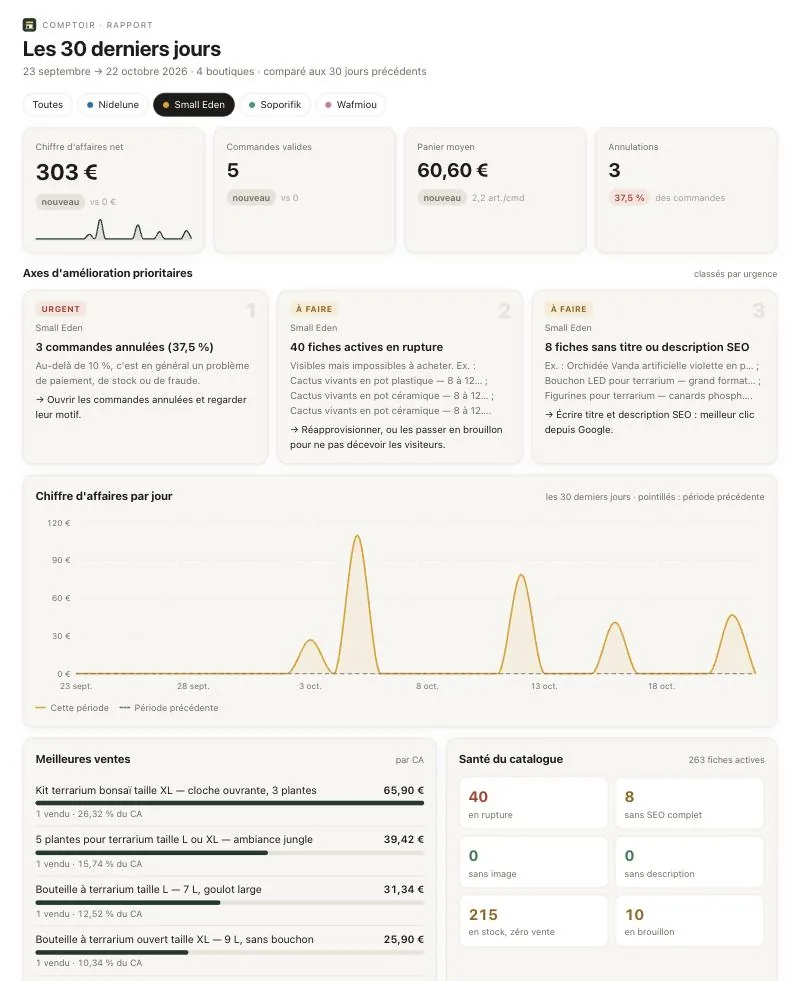
That is the principle behind Comptoir: from a conversation, you change prices, stock, product pages and translations across several Shopify stores in a single request.
A few rules for tools:
- Read and write kept apart. An agent that analyses does not need to modify.
- Confirmation before anything that cannot be undone. Changing a price on five stores gets approved first.
- A log of everything. Each tool call is recorded, with its parameters and its result.
Put guardrails in place
An agent makes mistakes, like everyone. The system has to plan for it.
- A verifier. On Votons, quiz cards are prepared by agents, each one reviewed by a verifier agent, then by a human.
- Rules in the code. Votons’ neutrality is enforced by code: anonymised positions, left-right parity. It is not left to an instruction.
- A capped budget. Alfred’s agent works under a spending cap. A runaway loop stops by itself.
- Tests on real cases. A set of questions with expected answers, replayed at every change of prompt or model.
Agents that work on their own
Not every agent chats. The most useful ones run without being spoken to: at a fixed time, or when an event occurs.
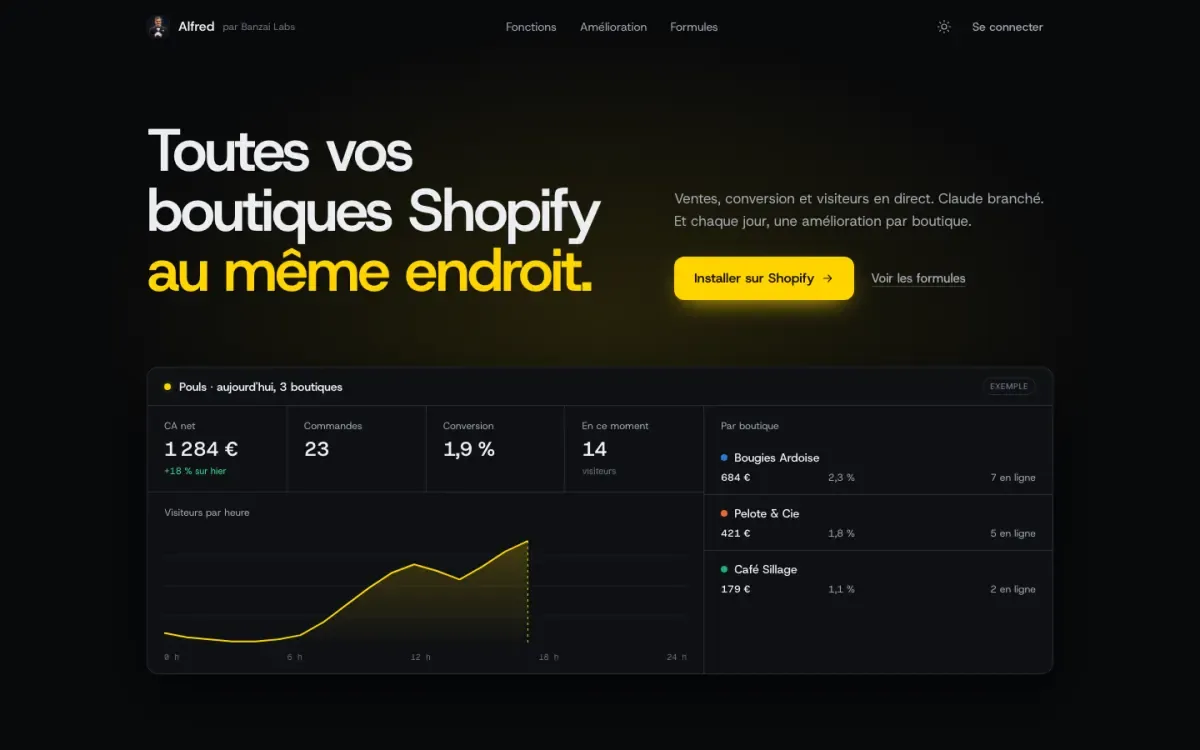
Alfred is one example. At each store sync it produces findings (stock-outs, conversion, loss-making ads, SEO), a morning brief and a Monday report.
For this kind of agent, we define:
- the trigger (a time, an event);
- what it may do alone, and what it may only propose;
- where it reports, and to whom.
Banzai Labs, Claude partner
Banzai Labs is part of the Claude Partner Network, the program Anthropic launched in March 2026 for firms that help businesses adopt Claude.
The program gives us access to Anthropic’s training and methods, its technical certification, and its engineers when a client project calls for them. For you, that means agents built along the practices Anthropic recommends, with direct access to its technical teams on the hard cases.
- Training
- Anthropic Academy materials and the sales and deployment playbooks used by Anthropic’s own teams.
- Certification
- Claude Certified Architect, the technical exam for building production applications with Claude.
- Technical support
- Anthropic engineers on live client projects, and architects to scope complex integrations.
Where to start
Pick a task that comes back every week, that relies on data you already have, and whose result is easy to check. A report, a triage, a watch. Have an agent do it in read-only mode for a month, compare with the human work, then widen its permissions.
Frequently asked questions
- What is the difference between a chatbot and an AI agent?
- A chatbot answers with what the model knows. An agent has tools: it reads a database, calls an API, edits a product page, then reports on what it did.
- How do you stop an agent from making up answers?
- By forbidding it to answer from memory. It must fetch the text or the data, answer from what it found, and show its source. When it finds nothing, it says so.
- How much does an AI agent cost to run?
- It depends on the model and on how much text is processed per request. You control it with a spending cap, lighter models for simple tasks, and caching for whatever repeats.