GuidesMCP
MCP server: connecting Claude and ChatGPT to your tools
What an MCP server is for
An assistant such as Claude can reason and write. It knows nothing about your orders, your stock or your customers, and cannot change anything there. An MCP server closes that gap: it presents your systems to the assistant as tools.
The user asks in plain language. The assistant picks the tools, calls them, and reports back.
A concrete example
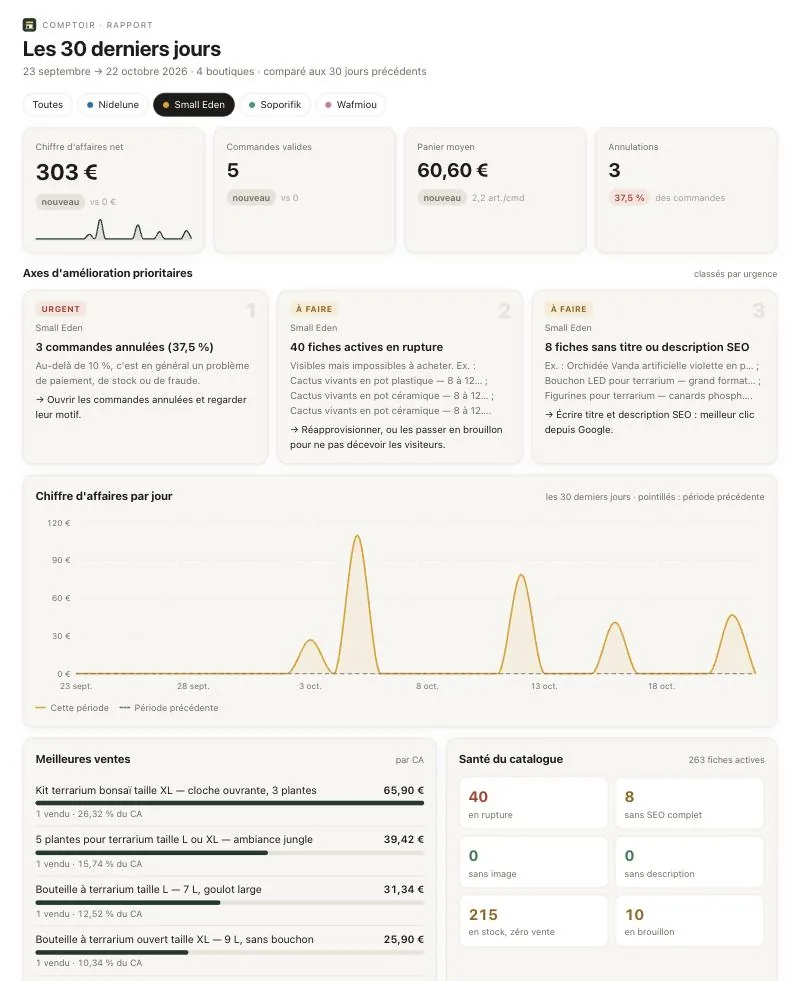
Comptoir, one of our projects, is an MCP server for Shopify merchants. The Shopify admin manages one store at a time. With Comptoir, you change prices, stock, product pages and translations across all your stores in one request, and get a monthly report right in the conversation.
What an MCP server exposes
| Element | Role | Example |
|---|---|---|
| Tools | Actions the model can call | “Update a product’s price” |
| Resources | Data to read | The catalogue, a report |
| Prompts | Ready-made request templates | “Monthly report” |
Designing good tools
A tool is read by a model, not by a developer. Its description does the job of documentation.
- A name that states the action
search_orders, notquery2. - A precise descriptionWhat the tool does, when to use it, when not to.
- Few parametersWell named, with default values.
- Short responsesWhat the model needs to decide, not a full export.
- Explicit errorsThat say how to correct.
Ten well-designed tools are worth more than a hundred generated from an API.
Security
- Read and write kept apartA tool that looks things up never modifies.
- ConfirmationBefore any action that cannot be undone, with the detail of what will change.
- The user’s permissionsNot those of an all-powerful account.
- A logWho asked what, which tool was called, with what result.
- Distrust of content readText retrieved from an email or a page may contain hidden instructions. The server must give them no power.
Where an MCP server runs
- LocallyOn the user’s machine, for personal use.
- RemotelyOn your server, with authentication, for a whole team.
The remote version is deployed like an API. Our guide Hosting on a VPS covers the essentials.
When to build one
- Your teams spend their time moving between several back offices.
- You already have APIs, or a well-structured database.
- The actions are repetitive and can be described clearly.
If the data is mostly documents, start with a RAG. If the need is a task that runs by itself, see AI automation.
Frequently asked questions
- What does MCP stand for?
- Model Context Protocol. It is an open protocol describing how an AI assistant discovers and calls external tools: reading a database, querying an API, editing a record.
- What is the difference between an MCP server and an API?
- An API is made for developers. An MCP server describes its tools in a form the model understands: name, purpose, parameters. It usually sits on top of your existing APIs.
- Is it risky to let an AI act in your tools?
- The risk is controlled by design: read tools separated from write tools, confirmation before anything that cannot be undone, permissions limited per user and a log of every call.